Tammy Ayres – February 2026
Across all six locations, the intersection of drug criminalisation and imprisonment is inseparable from mental health outcomes, both inside prisons and in the communities from which incarcerated populations are drawn. While the six-case study countries differ in scale, demography and drugs, this research aims to see if all reproduce a post-slavery order in which racialised suffering is criminalised, medicated and/or imprisoned.

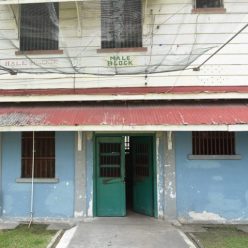
HMPS Mazaruni, British Guiana, 19th century
All locations relied heavily on plantation slavery and African enslaved labour introduced by the colonisers (British, Dutch and French) largely for sugar production. Abolition of slavery (1834-1838) did not end coercion however, as it was followed by apprenticeship systems and/or indentured labour (mostly Indian), which has produced enduring racialised class stratification, linking Africaness/Blackness to disposability, inequality and labour extraction. Colonial governance normalised violence as a form of order and produced legal systems that were designed not to protect people, but to protect property, suppress resistance, and discipline racialised labour. These systems were not dismantled after abolition; they were modified and retained, continuing to regulate mobility, sexuality, cultural practices, mental illness, substances and their use (intoxication). As part of the colonial criminal justice systems, prisons were used to punish and incarcerate, disproportionately impacting the labouring and formerly enslaved peoples. Drugs were also framed as a moral failure, a criminal threat, racialised and classed, while historically their prohibition and criminalisation disproportionately affected, and continues to effect, poor, racialised populations. As shown elsewhere the criminalisation of some substances but not others often replaced plantation discipline as a technology of control (Ayres, 2020, Ayres et al. 2021; Moss 2020; Moss et al. 2022; legacies that linger and haunt the present creating the colonial imaginary (see Ayres et al. 2024; Ayres, 2026).
The colonial imaginary describes the ideological framework that racialised, classed and moralised populations under colonial rule, and continues to shape contemporary society in these countries including drug prohibition, which produces selective criminalisation of substances and people, maintaining social hierarchies and masking structural harms inherited from slavery, indentured labour, colonial governance and global capitalism (Ayres et al. 2024). As the author has argued elsewhere, this is part of the Global Drug Apartheid
‘where drug policy and legislation – now and historically – has created a hierarchy of institutionalised segregation, which privileges certain substances and their users whilst criminalising and punishing others. This drug apartheid represents a system of inclusion and exclusion…Resultantly, whilst the drug apartheid proliferates drug related harms most acutely on those populations who are already economically and politically marginalised, its remit is said to permeate the entire social strata’ (Ayres and Taylor, 2025:76-77; Taylor et al. 2016).
Across all six case-study countries, drugs for the most part remain prohibited (possession and supply) with one exception, cannabis. Cannabis in Jamaica was first formally decriminalised in 2015 for medicinal, religious (e.g. Rastafarianism) and small-scale personal use. It is currently the only Caribbean (CARICOM) country to do so, although in 2019 Trinidad and Tobago and in 2021 Barbados amended their drug laws also to introduce fines/fixed penalties for possession of small quantities of cannabis, and have also regulated medical and sacramental cannabis. Guyana, has done similar, and no longer sends people to prison permits persons for possession of 30 grams or less of cannabis (see Ayres, 2020)[i]. These changes to cannabis reflect wider trends around the world as cannabis seems to have become seen as the natural first choice for decriminalisation and legalisation. The contemporary privileging of cannabis as the ‘obvious’ first drug for reform reproduces the colonial logic of the 1961 UN Single Convention, which classified substances not by harm but by racialised, cultural and economic hierarchies, legitimising selective inclusion while leaving the punitive architecture of drug prohibition intact. A there is no scientific basis for privileging cannabis over some other drugs, which have been deemed to be less harmful, illustrating that this decision is political and populist, not evidence-based.

View of the conference room on January 24, 1961 at the United Nations in New York. UN Photo: United Nations Conference for the Adoption of a Single Convention on Narcotic Drugs | United Nations
Despite the lack of evidence base underpinning drug prohibition, all other drugs are prohibited via legislation – Mauritius (Dangerous Drugs Act), Seychelles (Misuse of Drugs Act), Barbados (Drug Abuse (Prevention and Control) Act), Trinidad and Tobago (Dangerous Drugs Act), Guyana (Narcotic Drugs and Psychotropic Substances Act), and Jamaica (Dangerous Drugs Act) – although the most commonly used drugs tend to differ across countries, which is reflected in their annual reports and/or drug policies (Mauritius (National Control Drug Master Plan 2019-2023), Seychelles (Drug Control Master Plan 2009-2012), Barbados (ASKED JAN), Trinidad and Tobago (The Operational Plan for Drug Control 2021-2025), Guyana (Drug strategy Master Plan 2016-2020), and Jamaica (National Drug Prevention and Control Master Plan 2015-2019). While cannabis is used in all, alongside other recreational drugs like cocaine and ecstasy/molly, opiates like heroin although present in the Caribbean, use is rarely reported, compared to Mauritius and the Seychelles, which has been described as having a ‘heroin crisis’ with the ‘highest per capita rates of heroin use in the world.’ This is largely because both sit along major heroin trafficking routes (and growing regional methamphetamine and cocaine routes) and illustrates how mental illness, addiction and punishment converge. Whilst all locations are transit routes for drugs, albeit for slightly different drugs, Barbados has a lower trafficking role than the others, which research shows impacts levels of guns and violence in these countries (Bird et al. 2021; CARICOM et al. 2025), and prison violence, where drugs have been linked to organised crime (e.g. in Jamaica[ii]).

Union Vale Prison, Seychelles, C. 1952
Although changes to cannabis laws have reduced arrests and imprisonment for cannabis-related offences, significant numbers of people continue to be incarcerated for drug possession and trafficking across all case-study countries, with data often incomplete or uneven. In Mauritius, for example, 21.5% of convicted drug offenders were imprisoned in 2023, including a disproportionate number of foreign nationals and women; notably, 20% of women in prison are incarcerated for drug-related offences, despite women comprising only 20% of the total prison population. Comparable patterns are evident elsewhere: in Guyana, 21% of the prison population is incarcerated for drug-related offences (14% of all incarcerations in 2022), the majority linked to cannabis, while in Barbados drug offences accounted for 11% of all imprisonments in 2022 and in 2020, the only drug offence women were imprisoned for was possession. Across all locations, the continued criminalisation of drugs has contributed to prison overcrowding – particularly acute in the Caribbean (e.g. Guyana 60%, Trinidad and Tobago (38%), Jamaica (36%) and Barbados (2%)), while simultaneously displacing unmet mental health needs into the penal system, where substance use disorders and psychological distress are managed through punishment rather than care. In these contexts, prisons operate as de facto psychiatric institutions, now as they did historically (e.g. see Anderson and Halliwell, 2024), absorbing populations for whom community-based mental health infrastructure is limited or inaccessible.
Therefore, the overall aim of this research is to see if drugs cultures and addiction in prisons are rooted in colonial-era health practices, law and population management and not solely in modern medical regimes and criminal justice system. It will examine whether drugs, mental illness and prisons function as postcolonial substitutes for slavery’s management of excess undesirable and vulnerable populations and can be understood as a continuation of plantation-era population management. In postcolonial countries these vulnerabilities are intensified by histories of enslavement, indenture, racialised poverty and ongoing social exclusion.
[i] Mauritius and the Seychelles have introduced limited provisions for medicinal cannabis, recreational possession and supply are still criminal offences punishable by imprisonment with penalties in the Seychelles being the strictest in the region.
[ii] ‘A mass killing in August 2024 was committed by detainees Jamaica involved in organised crime’ in Jamaica.
