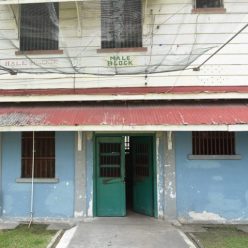
Prisons, Drugs and Mental Health: an interdisciplinary study
Clare Anderson – January 2026
It is my great pleasure to launch this blog, which accompanies a new research programme generously funded by a Wellcome Trust Discovery Award. “Prisons, Drugs and Mental Health: an interdisciplinary study” aims to fill gaps in knowledge about drugs/ addiction in prisons and their relationship to mental health. This is important because evidence suggests that drug laws and enforcement disproportionately affect already marginalised populations, and drug users in prison have poorer health and socio-economic outcomes. We also know that incarceration has profound mental health impacts, including for prisoners and their families and the people who work with them. However, we do not fully understand the historical genesis of the relationship between prisons, drugs and mental health – or their impacts – and finding out more about this is the ambition of our 5-year programme.
We bring together a team of researchers from the UK, Caribbean and western Indian Ocean with expertise in History, Criminology, Law, Political Science and Postcolonial Literature. Our multi-disciplinary team is working on the case studies of Barbados, British Guiana/ Guyana, Jamaica, Mauritius, Seychelles, and Trinidad & Tobago. These countries share histories as former British colonies with complex histories of enslavement and migration, connected to the production of sugar and other export commodities. We are taking an interdisciplinary approach, integrating research in historical archives with oral histories, modern records, interviews and focus groups, and arts-based work (including art, poetry, music). Working co-creatively with researchers, prison services, communities and NGOs, we want to find out to what extent drugs cultures and addiction in prisons today, including the use of prescription medication, are rooted in colonial-era health practices, law, and population management and not solely in modern medical regimes and criminal justice systems. In this work, we are interested in the perspectives and experiences of prisoners, prisons personnel, and wider communities.
Our aim is to identify the multisystemic factors – medical, socio-economic, cultural, institutional – that can help trace connections and disconnections between historic practice and the present day. We believe that colonial histories of drugs as social rather than individual determinants of mental health are poorly understood and want to rectify this by using decolonizing and culturally affirming methodologies to create ‘useable pasts’ and explore their global impacts now. Therefore, overall, we are asking the question: How do historical logics inform the presence, use, and impacts of drugs among prison communities, particularly in terms of addiction and mental health, in colonial and post-colonial locations, since 1800?
I am an historian and began my own research on punishment during my PhD research, in the mid-1990s, which focused on 19th-century Mauritius. I later became interested in how punishment (and penal labour) in Mauritius was connected to other Indian Ocean locations, and more recently how the history of British colonial punishment links to the histories of other polities and empires, including enslavement and other coerced labour regimes.
Over almost 30 years, I have worked on the Colonial Office holdings of Britain’s National Archives, and in the India Office collections now in the British Library, as well as in national and regional archives and libraries including elsewhere in Britain and in Mauritius, India, Australia, and the Caribbean.
My career took an interesting turn in 2016, when I had the opportunity to visit Guyana. Welcomed by the University and the Prison Service, I had the chance to visit the country’s three historic prison locations, at Georgetown, Mazaruni, and New Amsterdam. This was a life-changing trip for me, in that I felt that there existed a real urgency to unpacking the colonial histories and legacies of the criminal justice system in the country. A solid partnership evolved, and has endured now for ten years, between University of Leicester and University of Guyana researchers, and Prison Service personnel. In previous work, generously funded by the British Academy and the ESRC, we were able to research the history of prisons in the colony/ country, and work with the Prison Service to produce materials of value to their training programmes and modernisation programme.
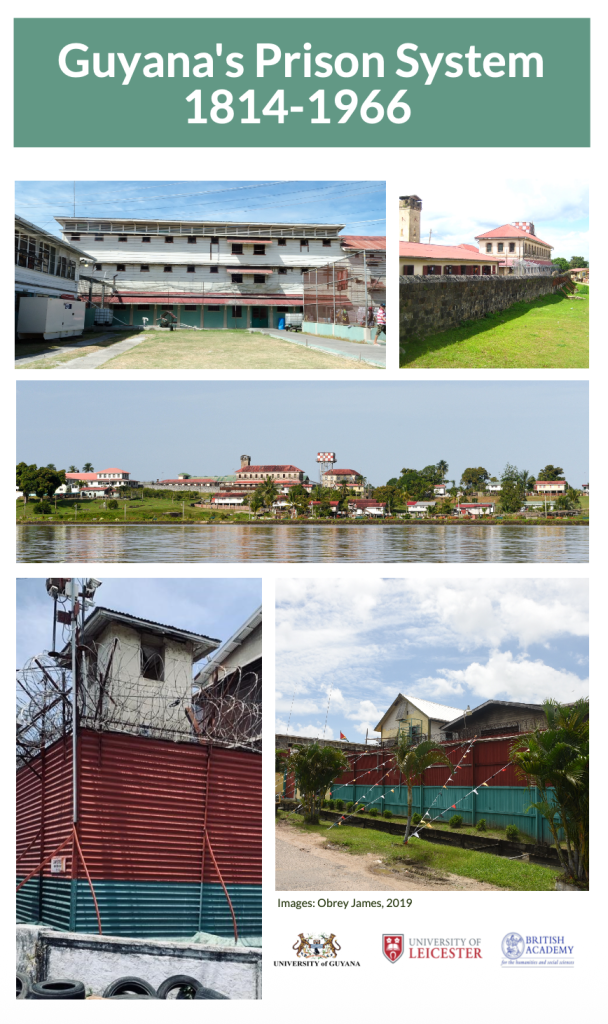
The short historical pamphlet that we produced is now used by the Guyana Prison Service in its training and public communications programme.
The significant Wellcome Trust investment that we now have the privilege to hold will enable us to take this work to the next level. We are rolling out our programme to five other colonies/ countries and broadening our methodologies in response to what we learned about data collection, together, over the past decade. Co-investigator Dr Kellie Moss is leading the “history” work on this programme, but I have already had the opportunity to research in the Caribbean and Indian Ocean collections held by the Wellcome Library and the National Library of Scotland.
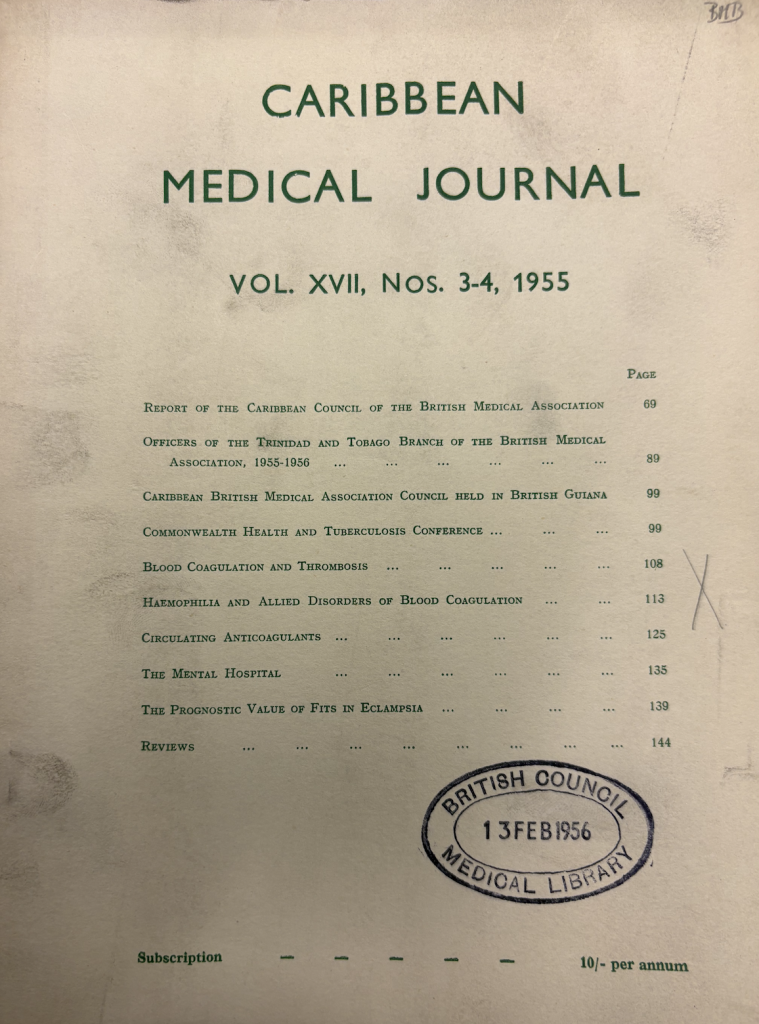
The Wellcome Library holds a wonderful collection of Caribbean medical journals.
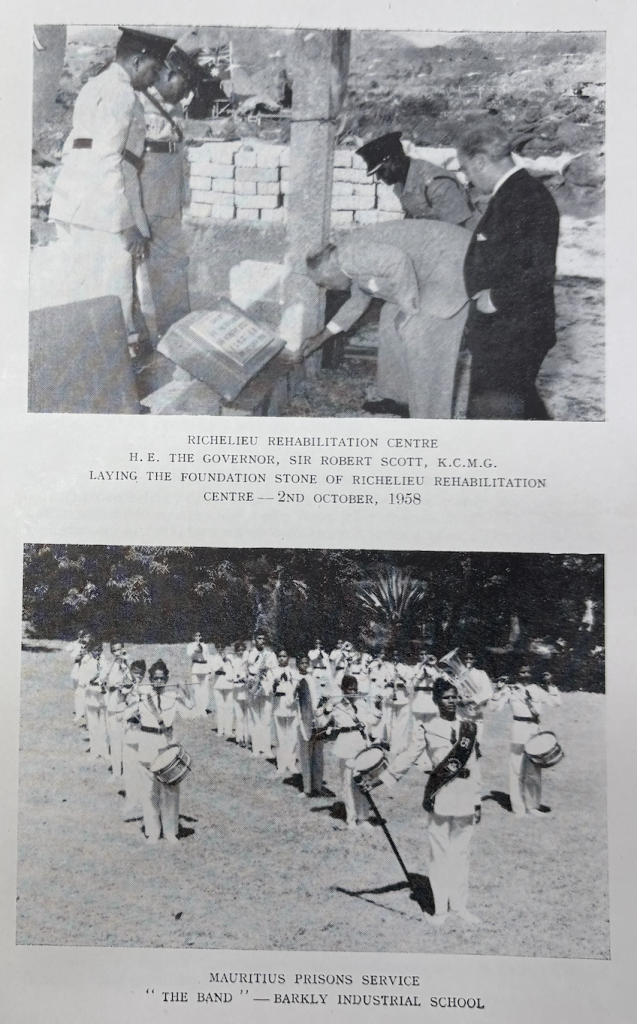
There are annual prison reports for Mauritius in the National Library of Scotland. These photographs are reproduced from the 1958 publication.
Later this year, we will be launching a call for applications to our programme network. We want to work with researchers who are interested in the histories and legacies of colonial incarceration in other global contexts. The broadening of our work to other colonies and countries will produce a unique new perspective on the aftermaths of empire in criminal justice systems all over the world; a perspective that we hope will make an important contribution to the scholarly literature and have real-world application.
The team will blog in rotation, and we hope that readers will enjoy reading about our work, as it progresses. In the meantime, you might be interested in exploring the blog that accompanied our previous work, on mental health, neurological and substance abuse disorders in British Guiana/ Guyana, and the collection of academic and stakeholder outcomes of that work. Please also keep an eye on our programme website, which can be found here.