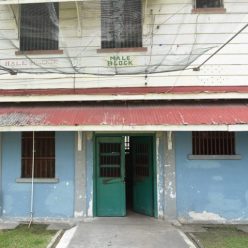
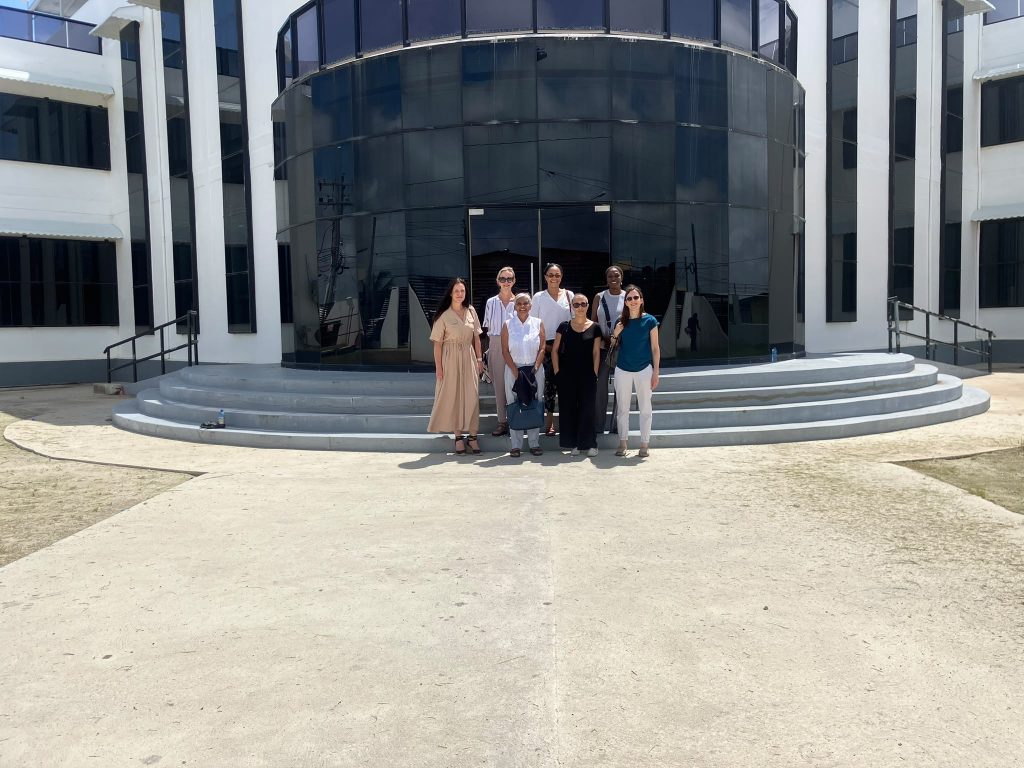
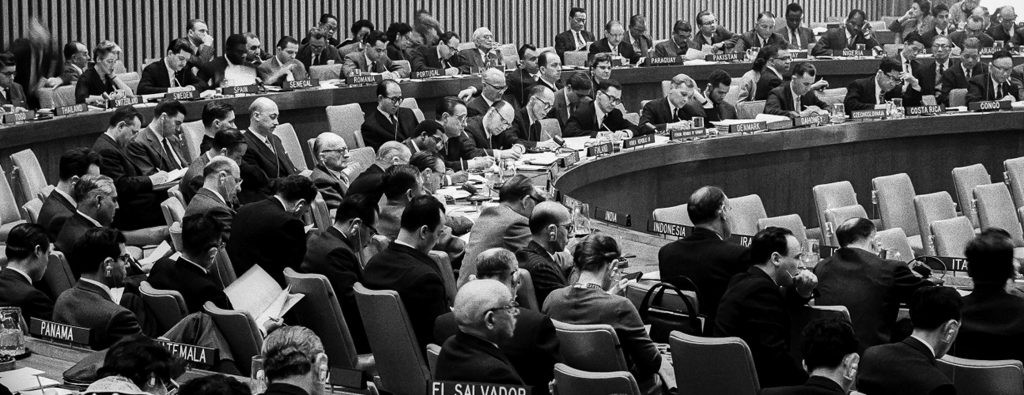
On 18 June 2026, the Wellcome team convened a leadership workshop for senior offices of the Guyana Prison Service and the Bordelais Correctional Facility in St Lucia. It kicked off with three presentations. Clare Anderson spoke about history, colonial legacies and lessons for contemporary prison leadership. The goal was to encourage discussion and understanding of how colonial systems of punishment and inequality continue to shape modern prisons; and to nurture the use of historical lessons to guide the development of humane, effective, and inclusive correctional institutions. Tammy Ayres presented on ethical leadership, professionalism and staff well-being. She stimulated thinking on leading with integrity, accountability and transparency, on managing stress and building resilience, and building partnerships to support well-being and training. Mellissa Ifill focused on the treatment and management of vulnerable groups in custody. Centring women and particularly foreign nationals in her presentation, she stressed the need for gender-responsive rather than gender-neutral policies and practices. These three talks stimulated group discussion, as senior leaders in the two prison services exchanged views on their experience of robust leadership and service in the sector.
On 2 July 2026, members of the Prisons, Drugs and Mental Health (PDMH) project participated in the roundtable Colonial Confinement and the Shaping of Public Perceptions of Mental Health at the Society for the Social History of Medicine (SSHM) Conference in Leeds. The session brought together researchers from the University of Leicester and partners in Mauritius to explore how colonial systems of confinement shaped public understandings of mental illness across the Caribbean and Indian Ocean worlds. Drawing on archival research, the roundtable examined the historical overlap between punishment and psychiatric care and considered how colonial practices contributed to enduring stigma surrounding mental health and access to care. The discussion highlighted the lasting impact of these histories on contemporary debates about imprisonment, wellbeing, and social inclusion.
Co-Investigator, PDMH & Ihtisham Miraj, Le Chantier, Mauritius
The attempt to reduce supply failed. Though in the late 1990s, the supply of heroin and gandia declined after an aggressive campaign against drug traffickers, they circumvented this and switched to chemical substances, normally used as medicines, classified as i) narcotics and ii) psychotropic drugs.
The Committee recommended that the private sector, such as the sugar estates, Police and clinics should not be allowed to operate pharmacies and dispense dangerous drugs. The legal framework in force was provided by the Dangerous Drugs Act 1986, The Psychotropic Substance Act 1974 and the Pharmacy Act 1983.
The 2000s: Recidivism and Organised Crime
Research by Chittoo et al. (2011) pointed to the failure of prisons to reform detainees or deter reoffending. In 2009, the total prison population across 11 facilities stood at 2,375. By May 2010, it had risen to 3,517 — prompting plans for a new prison. Recidivism increased by 27% between 2007 and 2010, and 85% of the 2010 prison population were serving a second or subsequent conviction. The increase was closely linked to the stricter Dangerous Drugs Act 2008. The human, social, and financial costs of recidivism are enormous for an island economy of only 1.3 million people. As Chittoo et al. argued, investing in the rehabilitation and reintegration of detainees into the labour force would generate a far better return than the ever-increasing cost of incarceration.
Many links between drug trafficking and other organised crime exist and had become impossible to ignore: prostitution, burglary, arms dealing, money laundering, the corruption of public officials, violence and intimidation, and fiscal fraud. Committees recommended an audit trail strategy as the “spearhead of the drug battle,” including lifting confidentiality provisions on certain financial transactions — gambling, betting, bank accounts — and better coordinating all enforcement agencies. Traffickers had also evolved their operations. Committees noted that traffickers had invested in legitimate and lucrative businesses, were very well- equipped: fast cars, portable telephones, motorcycles for pushers, high concrete walls around their houses and speed boats. It was obvious that enforcement agencies would not be able to keep up if they did not have adequate logistics.
Moreover, pedlars and pushers now kept only small quantities on them, hiding the rest at unknown locations so that if arrested, they would be charged as ‘users’ rather than traffickers. Intermediaries who carried no drugs — only messages, money, or surveillance intelligence (known as martins) — further complicated prosecution. The proliferation of selling points made entire neighbourhoods feel unsafe, with even police completely unable to enter certain areas.
By this point, it was clear the prevention of trafficking had failed, the support to addicts outside of prisons was inadequate, the ‘attempts’ at rehabilitation had failed, the harsher regulation simply filled the prison further, creating an issue of overcrowding, while the diversity of drugs had grown and the number of drug abusers had grown, even affecting young children.
2015–2025: The Synthetic Drug Crisis
In 2015, almost three decades after the original Rault Report, a second major Commission of Inquiry (2018) into drug trafficking was established, chaired by former Supreme Court Judge Paul Lam Shang Leen. Its findings were explosive: drug trafficking extended to the highest levels of the political establishment. Politicians, police, and lawyers were named and linked to trafficking networks, revealing a deep web of corruption. Among its key findings were that traffickers were conducting operations from inside prisons and that anti-drug agencies lacked coordination.
The Commission made over 400 recommendations. One implemented was the establishment of a National Drug Observatory. In 2019, the government launched the National Drug Control Master Plan 2019–2023, built on four pillars: supply reduction, demand reduction, harm reduction, and coordination. NGOs reported mitigated success — funding, willingness, and sustained support were lacking. And it did not curb the synthetic drug crisis.
Since 2015, arrests related to synthetic drugs have increased every year. Synthetic drugs are easily manufactured locally, mimic the effects traditional substances like marijuana, cocaine, and ecstasy, and are effectively impossible to monitor — producers replace chemical compounds faster than law enforcement can detect them. Around 95% of the raw ingredients are imported from China, and some synthetic drugs can be produced at home using pesticides, rat poison, rubber, and detergents. By 2024, it was estimated that over 100,000 people in Mauritius were consuming drugs. The most dangerous currently are “blue” — a synthetic drug that reduces users to a near-catatonic state — and crystal methamphetamine, which causes gangrene.
The marketing of drugs has also changed: sold in smaller quantities and at higher prices every time it changes hands, they are now accessible to increasingly younger users. A “democratisation” of the drug economy has occurred, with an epidemic of synthetic marijuana produced in Mauritius and use reported among children as young as eight, cutting across all social classes and all regions of the island.
What Must Change
It is clear that the methods used 40 years ago to combat drug trafficking no longer work. Hopes are now centred on the new National Agency for Drug Control (NADC), which coordinates bodies including:
ADSU,
Financial Crimes Commission,
Mauritius Revenue Authority Customs,
National Coast Guard,
Ports Authority
Financial Intelligence Unit.
Its five priority areas are: centralised intelligence analysis; strengthened inter-agency coordination at ports and maritime borders; targeting the financial flows of criminal networks; addressing the links between prisons and drug supply; and deepening regional and international cooperation.
Repression remains necessary but must be reformed. Huge sums continue to be spent on enforcement while treatment of drug-related health issues remains underfunded — a damaging imbalance. Repression must target the major traffickers and those who support them, including money launderers, rather than focusing exclusively on small and mid-level operatives. Corruption reaching the upper levels of the public and private sectors must be confronted directly. And the traditional approach of targeting particular communities must not be repeated.
Investment in health must expand. Not all drug users suffer from mental or physical health problems, nor are all in difficult economic circumstances. Policy must be targeted accordingly. Crucially, alcohol must no longer be excluded from the conversation — it is consumed alongside drugs and is equally damaging to health, lifestyle and family structure, yet Commissions have consistently overlooked it because its sale is legal. The continued criminalisation of all drug users reflects a colonial legacy: policies introduced by British authorities against opium and marijuana, substances that were culturally embedded across Asia and Africa long before they were deemed criminal.
Demand reduction is especially important in areas known for drug activity. NGOs are doing valuable work but require greater public funding. Drug education should be embedded in school curricula — for too long, authorities denied that drug use was a problem in schools, even as children were found peddling in primary classrooms. However, NGOs have warned that the ‘new version’ of traditional drugs introduced in the market are different from the older ones and so the treatment of users and addicts is getting difficult as the new drugs have a different impact on the body, it is harder to diagnose and yet to be studied and remedies found. Worse, as the marketing of the drugs has changed, drugs are sold in smaller quantities, thus cheaper, and more accessible to younger users.
Dismantling organised crime requires targeting the financial infrastructure of trafficking networks. The recent seizure by the frigate Floréal of drugs with a street value of Rs. 3.5 billion — destined for Mauritius — raises the question that has echoed through every Commission of Enquiry for four decades: who is really behind drug trafficking in Mauritius? Until that question is answered honestly, and until those at the top of the trade are named, prosecuted, and convicted, all other efforts will remain incomplete.
For further reading
Ann Fordham. The war on drugs is built on racism. It’s time to decolonise drug policies. 26 June 2020 International Drug Policy Consortium.
Richard Chelin. ‘Breaking Bans The scourge of synthetic drugs in Mauritius’ Research Paper 15 / ENACT September 2020.
D. Gaël Henriette-Bolli, Viraj Fulena, Hemant B. Chittoo, Emily Payen. ‘Analysing Provisional Charges in the Mauritian Criminal Justice System’, International Journal of Social Science and Human Research, Print): 2644-0679, 6. 11 November 2023.
D. Gunnoo. ‘Treatment of drug offenders in the Mauritius’. 2018,
Harish Khooblall, Hemant B. Chittoo, A. Bholoa ‘Trends in Incarceration and Recidivism in Mauritius – Raising the Alarm’ Global Journal of Human Social Science, 11, 7 November 2011.
Reports by NGOs
Collectif Urgence Toxica (CUT) and Harm Reduction International
(HRI) Joint Submission To CESCR: Review of Mauritius- List of Issues 16 July 2025
PILS. Image and perception of drugs in Mauritius, http:// pils.mu/wp-content/uploads/2017/03/TNS-Image-and-perception-of-drugs-in-Mauritius.pdf, 2018.
PILS. Image and Perception of Drugs in Mauritius, http://pils.mu/wp-content/uploads/2017/03/TNS-Image-andperception-of-drugs-in-Mauritius.pdf, 2018.
Reports of Select Committees and Commissions
Mauritius Police Force, Annual Report Publication, June 2023-June 2024.
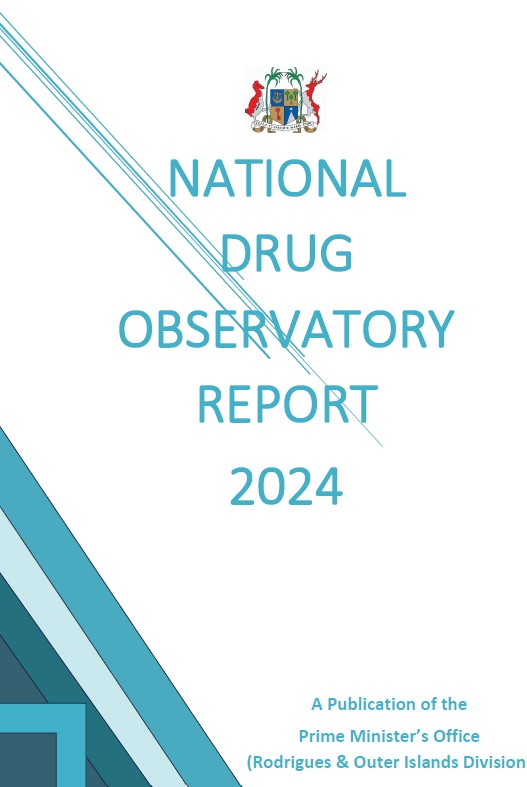
National Drug Observatory Report, National Drug Observatory. 2024.
Select Committee – Amendments to Dangerous Drugs Bill,1986.
The Prisons, Drugs and Mental Health (PDMH) project hosts and attends a range of events, including seminars, workshops and public discussions, bringing together researchers, practitioners and policymakers to explore key issues at the intersection of criminal justice and mental health. These events provide opportunities to share findings, foster interdisciplinary dialogue and build international collaborations.
Please use the drop-down arrow in the menu to explore upcoming and past events in more detail and find out how to get involved.
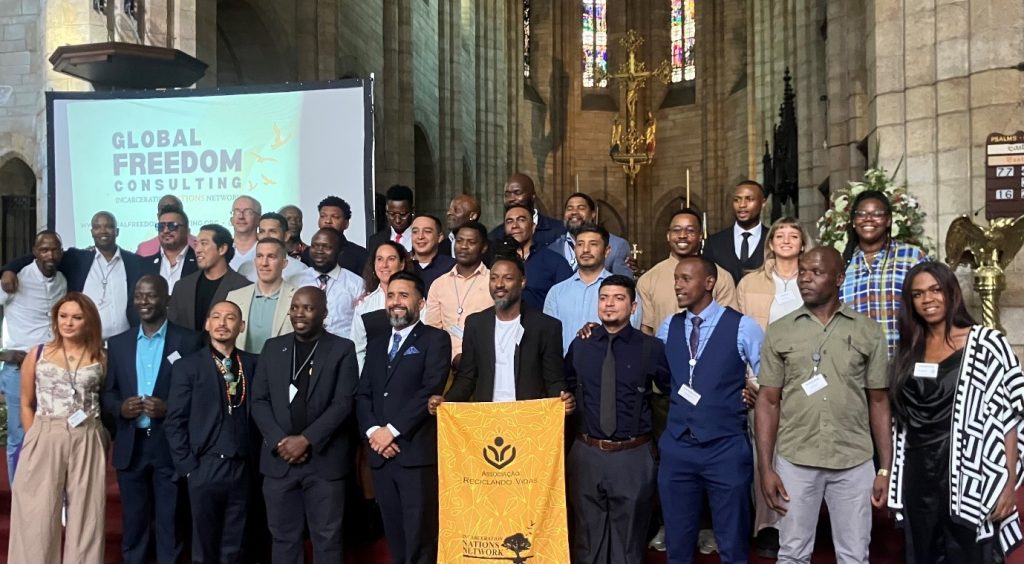
Team members attended the launch in Cape Town of the Global Freedom Consulting Agency in April 2026, which is a pioneering initiative that positions formerly incarcerated people as global experts in justice reform. For the team members that attended, the event highlighted how lived experience could be reframed as a legitimate form of knowledge and leadership, challenging traditional hierarchies in criminal justice policy and promoting more transformative, community-led approaches to research and reform. Read our blog on the event here.
Co-Investigator, PDMH & Ihtisham Miraj, Le Chantier, Mauritius
Despite the obvious connections dating to our common colonial past, I cannot say that my background in studying the history and impact of slavery, indenture and other forms of unfree labour of Mauritius prepared me for this multidisciplinary study of Prisons, Drugs and Mental Health. Today Mauritius is considered as one of the transit points in the international drug trade. This and the unexplained deaths of incarcerated persons in prisons have become the hottest topics in the media in Mauritius today.
Although the drug trade became noticeable in Mauritius in the 1980s, around the same time as in the Seychelles, it has since evolved to a scale that earlier analysts could not have predicted. Yet, the warnings were there: Commissions of Enquiry succeeded each other every few years, and accusations against alleged drug lords surfaced periodically, with some hiding behind parliamentary immunity to assert the most objectionable of claims. What all past and recent Commissions have in common is their outlining of dangers to young people, as the variety of drugs available grew and the creative techniques used to smuggle them into and within Mauritius became increasingly apparent. Despite public outrage, stricter laws, and heavy punishments, the most significant drug traffickers and their accomplices have yet to be successfully named and prosecuted.
One major shift since the 1980s and 1990s has been the impact of social media. Today in Mauritius, there is at least one social media post per day about a presumed trafficker or addict from online news outlets. Suspected users are filmed without consent and publicly humiliated, with clips openly shared online. There is considerable public pressure to reduce the drug trade and prevent young people from succumbing to peer pressure. Yet how the trade began, and who was behind it, remains unknown to most. What is certain is that today, drugs affect every corner of Mauritian society and the economy, importantly.
Alcohol and tobacco are also consumed by a large section of the population, creating other forms of addiction which are understudied in connection to studies on drug addiction. Other addictive and dangerous drugs are prescribed by the medical profession. Consumption and sale are all perfectly legal and involve big business. Commissions of Enquiry on these have yet to be set up. It cannot be understated how the pro-business decisions of successive governments and the inability of the civil service and law enforcement to deal effectively with the proliferation of the drug trade has led to the situation today.
The Challenge of Research
Studying the history of the drug trade and prisons in Mauritius is a difficult undertaking. They reside and share active roles within a sphere that includes money laundering, financial fraud, trafficking, arms dealing and violent crime. Despite the profusion of Commissions, Committees, reports, and parliamentary debates over the past 40 years, successive generations of researchers still struggle to obtain, for example, detailed biodata and case files to be able to draw up accurate profiles and make comparisons. Officials and politicians cite the protection of informants as justification for withholding information. There appears to be a deep distrust of NGOs and researchers, and an inability to distinguish scientific research from other forms of inquiry. While lawyers have unlimited access to detainees, researchers have none. There is therefore, an incentive to create our own research databases.
The failure to produce relevant scientific data has been devastating. The drug trade has expanded beyond what was imaginable 40 years ago, the number of addicts has skyrocketed, and hundreds — if not thousands — of families have been broken apart and today live in fear and desperation. This blog is therefore based on publicly available reports of various Committees established between 1985 and 2025, parliamentary debates, and media sources.
A Short History of Drug Use and Importation
The 1980s – How It Began
Before the 1980s, gandia and opium had traditionally been used by Indian and Chinese immigrants and their descendants, until opium imports were banned — somewhat ironically — by the same British Government that had encouraged opium cultivation in India and profited enormously from exporting it to China. Heroin was first introduced in Mauritius in the 1970s, and today the country has the highest prevalence of opioid use in Africa (Chelin, 2020). Opium was difficult to transport in bulk, so traffickers turned to importing heroin in a form that became known as ‘brown sugar’. The international heroin market had flooded traditional routes — the Golden Triangle and Golden Crescent — towards Western consumers, but wars such as the Iran-Iraq conflict and the Soviet invasion of Afghanistan disrupted these routes. Mauritius and a few other countries were chosen as transit points, largely because Mauritius was considered ‘relatively clean’ that is, it had a clean reputation and therefore would not attract international attention. External forces were thus largely responsible for the initial spread of ‘brown sugar’, though many at the time blamed local individuals. We could say this was the time Mauritius’ as a transit point for drugs began to grow. Beyond hard drugs, consumption of synthetic psychotropics also began globally, and Mauritius was no exception. Some were legally available, camouflaged as medicines — analgesics, tranquilisers, barbiturates, amphetamines — dispensed freely on prescription.
Drug Trafficking in the 1980s
The remote geography of Mauritius, local communities living in close proximity, the faded distinction between town and country, led observers to describe Mauritius as ‘one single town’. Young persons of whatever ethno-religious background were exposed to the same fashion or craze and took after it. The 1986 Rault Report noted that while trafficking was occurring, some public accusations were unreliable. One case in particular stood out. Within the Report, it drew up a first list of fourteen suspected drug tycoons, including a lawyer, the Head of the Anti-Drug Smuggling Unit (ADSU), an Assistant Superintendent of Police, and a well-known building contractor. When two were put on trial, their lawyers advised them to stay silent, resulting in minimal penalties. The Commission considered this an obstruction of justice. The fallout was dramatic. Parliament was recalled, and the fine on those obstructing the Commission was raised from Rs 1,000 to Rs 5,000,000. Members of the Legislative Assembly were accused of acting as couriers. Traffickers at this time were paying couriers to transport heroin along the Bombay-Amsterdam-Mauritius route. The Prime Minister ordered an investigation but did not anticipate that the head of the ADSU would be paid to ensure those couriers were not intercepted.
The 1990s: Resurgence and New Challenges
After the crackdown of the late 1980s, trafficking initially declined. However, it resurged in the 1990s. Several reasons were advanced: reduced vigilance, the return of freed traffickers, new networks, and changing global trends. As early as this decade, it was clear that traffickers were adapting — using body cavity concealment, decentralised distribution through multiple small-scale pedlars, and switching to chemical substances when heroin supply was disrupted. Authorities and institutions were unprepared and failed to anticipate any of this. The quick adaptability and unhindered growth of the criminal enterprise is a key reason for its prevalence today.
Issues with Prevention Strategies:
The profiling problem
The official profile of a trafficker in the 1990s was drawn solely from those arrested: a ‘suburban, semi-skilled worker, over the age of 25’. This approach contained among many, one fundamental flaw — it ignored those who were never arrested. The Commissions relied entirely on police statistics and never asked the critical question: do arrests reflect the true composition of the trafficking community? Those who used power and influence to avoid arrest were effectively exonerated by omission. This remains the largest gap in all documentation produced to date.
Profiling based exclusively on police data proved disastrous for the communities from which some traffickers came, imposing undue stigma and stereotyping. It is difficult to avoid the conclusion that drug laws were used to target people living in marginalised areas. Although the situations differ significantly, analogies with the racially discriminatory origins of the “war on drugs” in the United States are hard to dismiss. One Commission even acknowledged that its report had effectively exonerated a whole section of the trafficking community — those who used their power and influence to silence the truth. However, their Report did not want to profile and name names or identify locations of trade, such as the suburban housing estates, out of fear of ‘stigmatisation’ of particular communities. But the statistics collected have done exactly that.
However, arrests and prosecutions do show collusion of different socio-ethno-religious groups in the drug trafficking operations: taxi drivers, lawyers, peddlers, boat owners, politicians, their families, intermediaries etc.
Decriminalisation
The Boulle Report (1995) felt that decriminalising users would amount to admitting defeat, though it acknowledged this might reduce hard drug trafficking. With hindsight, one must ask: had decriminalisation been adopted then, would Mauritius be in its current predicament? In 1995, the Committee felt that there was no evidence of Mauritius being used as a transit point in the international drug trade. The possibility of this occurring was real due to Mauritius’ strategic geographical location, transshipment possibilities to Europe, Africa and elsewhere which could be exploited in the future.
Harsher laws
In 1992, the death penalty had not yet been abolished in Mauritius but it was envisaged and, in the meantime, the application of the death penalty was suspended. The use of the death penalty as a new deterrent, meant that ten persons — all foreign couriers — were sentenced to death for drug trafficking between 1988 and 1993. The Supreme Court reiterated that the mandatory death penalty for trafficking did not offend the Constitution. Two sentences were commuted; others remained under appeal. The death penalty was ultimately abolished.
Rehabilitation
Although the Prisons focused on Rehabilitation, there were several issues for example, the Commissions revealed that brown sugar and gandia were regularly available inside prisons, and the Commissioner of Prisons admitted that some officers were complicit with traffickers.
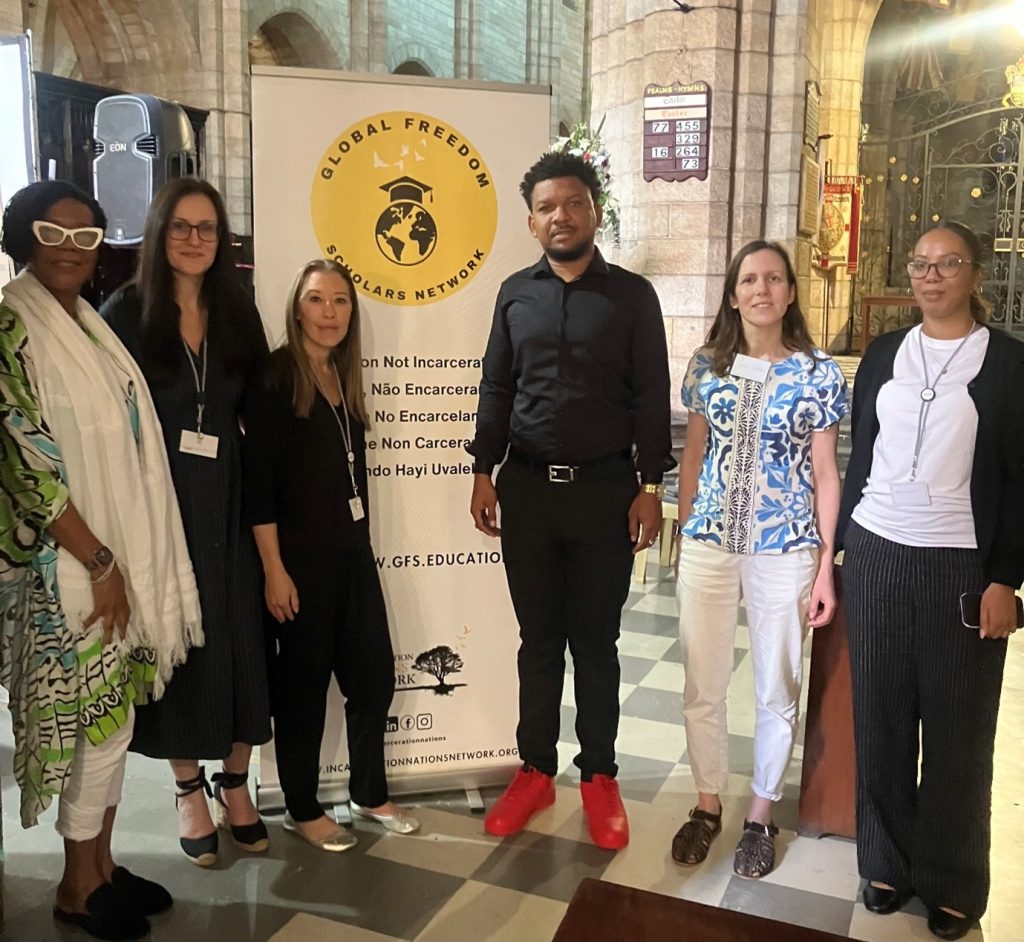
The Team and Nicholas Khan at the GFC event in St George’s Cathedral, South Africa
At its core, the event challenged dominant epistemologies of criminal justice by foregrounding lived experience as expertise. Although many of us put lived experiences at the forefront of our research, GF Consulting, formed from alumni of INN’s Global Freedom Fellowship, positions formerly incarcerated individuals not as subjects of reform but as architects of it. Over the past three years, the fellowship has trained leaders from 26 countries, many of whom now constitute a transnational network of consultants advising governments, institutions and civil society on issues ranging from education and reintegration to restorative justice.
Reframing Justice: From Punishment to Knowledge Production
The launch of GF Consulting represents a critical intervention in what scholars might describe as the politics of knowledge production within criminal justice systems. Traditionally, expertise has been monopolised by academics, legal professionals, policymakers and those in positions of power, often excluding those most directly affected by incarceration. This event disrupted that hierarchy.
At this event, lived experience was not treated as anecdotal but as analytical, strategic and indispensable for designing effective, context-sensitive interventions with real-world impact. This marks a shift that resonates with broader critical and decolonial frameworks, which interrogate whose knowledge counts and whose voices are systematically marginalised and excluded. By institutionalising formerly incarcerated leadership within a formal consulting structure, GF Consulting operationalises a counter-hegemonic epistemology; one that locates knowledge in embodied experience and social struggle, positioning lived experience at the centre of criminal justice solutions.
Education Not Incarceration: A Transnational Justice Movement
The event was not merely symbolic, but materially and geographically expansive. Hosted across historically and politically resonant sites, like St. George’s Cathedral and the Desmond and Leah Tutu Legacy Foundation, the event embedded contemporary justice reform within South Africa’s longer histories of resistance and reconciliation. The final day of the event was held at the Brandvlei Correctional Centre where we were joined by Unisa educators, prison officers and incarcerated people undertaking higher education and training,
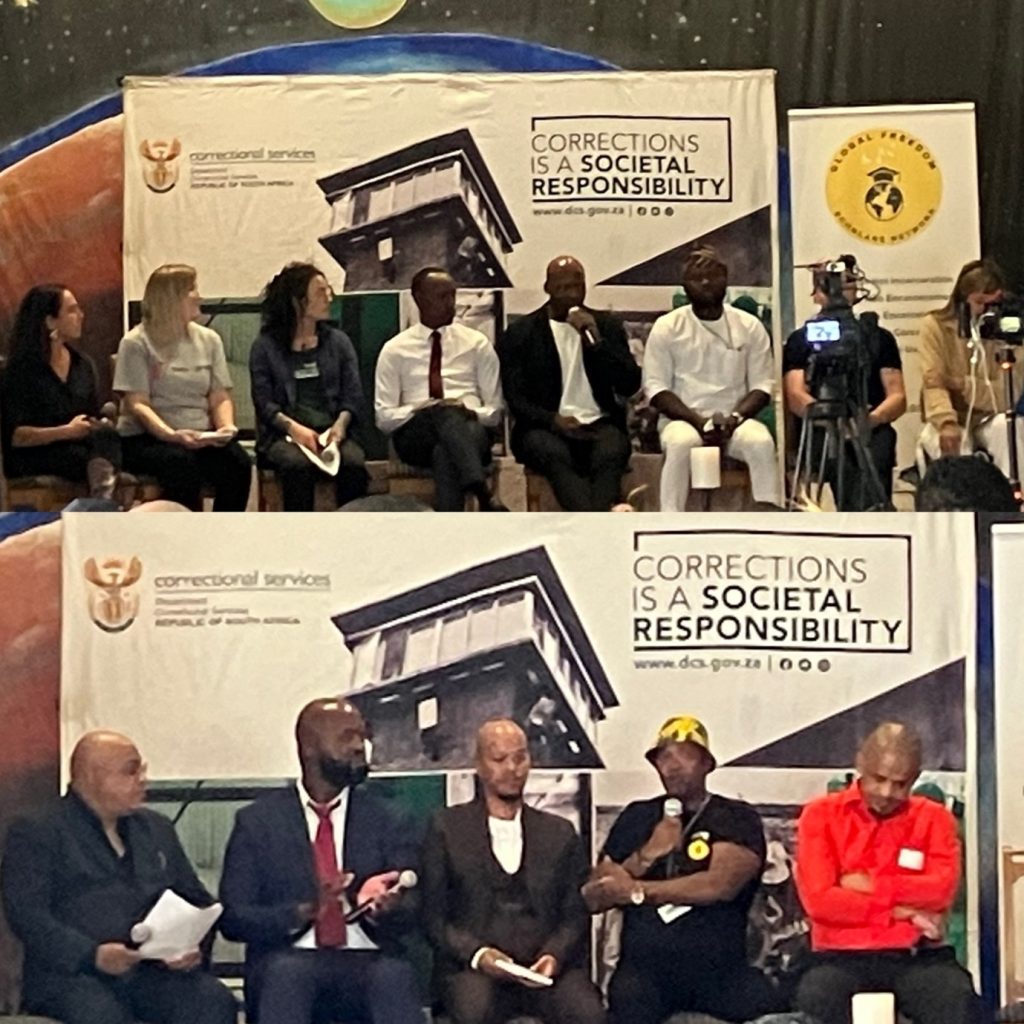
Event at Brandvlei Correctional Centre, South Africa – GF Scholars in Action and Unisa panel
The participation of global institutions, including the Office of the United Nations High Commissioner for Human Rights (OHCHR), alongside partners such as the Nelson Mandela Foundation and the Desmond and Leah Tutu Legacy Foundation, further underscored the international legitimacy and importance of this initiative. The presence of OHCHR’s regional representative for South Africa, Ms. Abigail Noko in the opening remarks signalled a recognition that justice reform is not solely a domestic policy issue but a global human rights imperative. Moreover, the diversity of participants and multi-lingual delivery highlighted the transnational nature of incarceration and its afterlives. Projects emerging from GF Consulting already demonstrate this global reach, including cross-border replication of intervention models and the development of international legal empowerment networks. We heard powerful and moving accounts from all of the Global Freedom Consultants at the event, some of who were unable to afford legal representation and had ended up being sentenced to death but studied law from their cells, organising and successfully arguing their appeal in the High Courts, and ultimately securing their own acquittal.
Lived Experience as Method and Praxis
What distinguished this event was not just the moving accounts and journeys of the Global Freedom Consultants, but their programmes, initiatives and drive to help and support others in similar positions. Panels, life stories, dialogues and performances, including spoken word poetry by Nicholas Khan, who wrote three poetry books in his cell (e.g. Nicko’s Ink), centred on what INN terms ‘justice innovation’ and ‘smart-on-crime’ approaches; frameworks that prioritise prevention, education and community-based solutions over punitive incarceration.
Importantly, the convening extended beyond conference spaces into sites of incarceration, such as Brandvlei Correctional Centre. Here discussions on education in prison foregrounded the transformative role of learning, aligning with South Africa’s longstanding histories, including the legacy of Nelson Mandela and his long walk to freedom, whose own intellectual formation during imprisonment continues to inform global imaginaries of resistance and rehabilitation. Other spaces included the Young Blood African Art Gallery, where the Writing on the Wall ‘pop-up art installation made from writings, drawings and notes by people in prison around the world’ was being exhibited.
From an academic perspective, the launch of GF Consulting invites several critical reflections. Firstly, it challenges researchers and practitioners to reconsider methodological approaches that exclude justice-impacted voices and lived experiences. Even though there has been a growth in participatory action research and co-production, often this does not go far enough, and in some instances, ends up being tokenistic. What Baz Dreisinger has done is not only put lived experience at the centre but institutionalise it as a form of expertise reconfiguring the epistemic architecture of criminal justice work, thereby transforming it from a consultative add-on into a foundational driver of knowledge production, policy design, and justice innovation, which positions justice-impacted individuals as authoritative agents in the production of knowledge rather than its objects/subjects. Secondly, it foregrounds the need to move beyond reformist paradigms toward transformative justice frameworks that address structural inequalities underpinning mass incarceration. As many of us acknowledge in our work and as Baz does in her award-winning book Incarceration Nations, criminalisation and incarceration reflects broader social inequalities and racial hierarchies that can be traced back to historical colonial inequalities and power structures.
Therefore, the three-day event in Cape Town marked more than the launch of a new consultation network; it signalled a reorientation of global justice discourse. By positioning formerly incarcerated individuals as knowledge producers and policy advisors, Incarceration Nations Network has catalysed a shift from carceral logics toward models grounded in dignity, expertise and lived reality that are needed globally. As GF Consulting begins its work, the challenge will be to sustain this momentum to ensure that lived experience remains not only visible but authoritative in shaping the future of justice systems, rehabilitation and reintegration worldwide.
Across all six locations, the intersection of drug criminalisation and imprisonment is inseparable from mental health outcomes, both inside prisons and in the communities from which incarcerated populations are drawn. While the six-case study countries differ in scale, demography and drugs, this research aims to see if all reproduce a post-slavery order in which racialised suffering is criminalised, medicated and/or imprisoned.
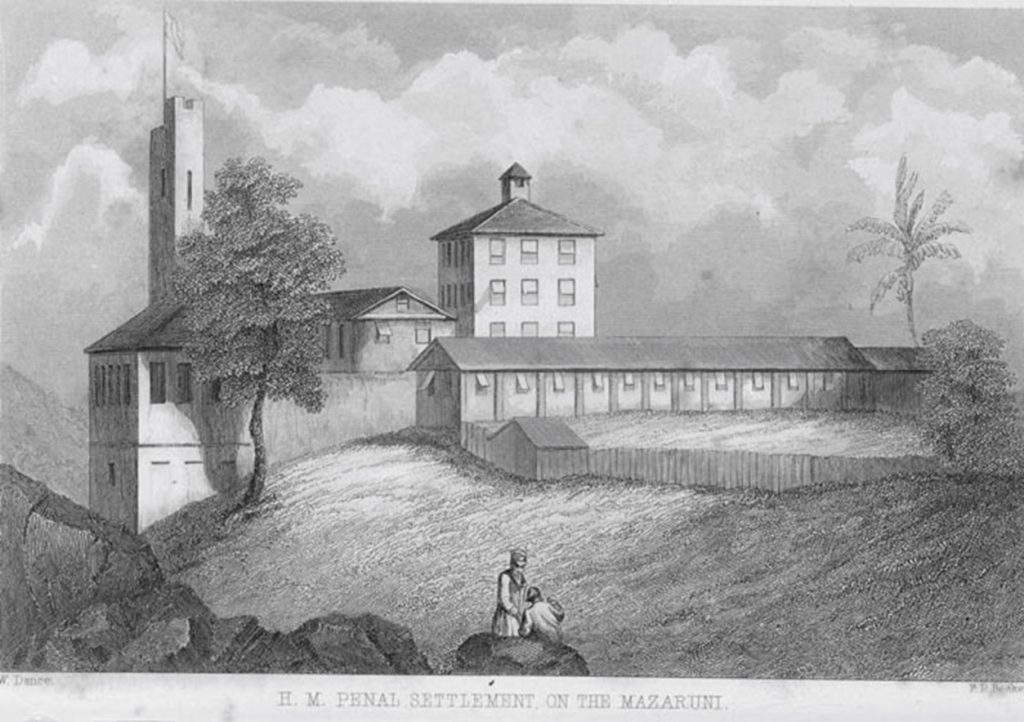
HMPS Mazaruni, British Guiana, 19th century
All locations relied heavily on plantation slavery and African enslaved labour introduced by the colonisers (British, Dutch and French) largely for sugar production. Abolition of slavery (1834-1838) did not end coercion however, as it was followed by apprenticeship systems and/or indentured labour (mostly Indian), which has produced enduring racialised class stratification, linking Africaness/Blackness to disposability, inequality and labour extraction. Colonial governance normalised violence as a form of order and produced legal systems that were designed not to protect people, but to protect property, suppress resistance, and discipline racialised labour. These systems were not dismantled after abolition; they were modified and retained, continuing to regulate mobility, sexuality, cultural practices, mental illness, substances and their use (intoxication). As part of the colonial criminal justice systems, prisons were used to punish and incarcerate, disproportionately impacting the labouring and formerly enslaved peoples. Drugs were also framed as a moral failure, a criminal threat, racialised and classed, while historically their prohibition and criminalisation disproportionately affected, and continues to effect, poor, racialised populations. As shown elsewhere the criminalisation of some substances but not others often replaced plantation discipline as a technology of control (Ayres,2020, Ayres et al.2021; Moss 2020; Moss et al. 2022; legacies that linger and haunt the present creating the colonial imaginary (see Ayres et al. 2024; Ayres, 2026).
The colonial imaginary describes the ideological framework that racialised, classed and moralised populations under colonial rule, and continues to shape contemporary society in these countries including drug prohibition, which produces selective criminalisation of substances and people, maintaining social hierarchies and masking structural harms inherited from slavery, indentured labour, colonial governance and global capitalism (Ayres et al. 2024). As the author has argued elsewhere, this is part of the Global Drug Apartheid
‘where drug policy and legislation – now and historically – has created a hierarchy of institutionalised segregation, which privileges certain substances and their users whilst criminalising and punishing others. This drug apartheid represents a system of inclusion and exclusion…Resultantly, whilst the drug apartheid proliferates drug related harms most acutely on those populations who are already economically and politically marginalised, its remit is said to permeate the entire social strata’ (Ayres and Taylor, 2025:76-77; Taylor et al. 2016).
Across all six case-study countries, drugs for the most part remain prohibited (possession and supply) with one exception, cannabis. Cannabis in Jamaica was first formally decriminalised in 2015 for medicinal, religious (e.g. Rastafarianism) and small-scale personal use. It is currently the only Caribbean (CARICOM) country to do so, although in 2019 Trinidad and Tobago and in 2021 Barbados amended their drug laws also to introduce fines/fixed penalties for possession of small quantities of cannabis, and have also regulated medical and sacramental cannabis. Guyana, has done similar, and no longer sends people to prison permits persons for possession of 30 grams or less of cannabis (see Ayres,2020)[i]. These changes to cannabis reflect wider trends around the world as cannabis seems to have become seen as the natural first choice for decriminalisation and legalisation. The contemporary privileging of cannabis as the ‘obvious’ first drug for reform reproduces the colonial logic of the 1961 UN Single Convention, which classified substances not by harm but by racialised, cultural and economic hierarchies, legitimising selective inclusion while leaving the punitive architecture of drug prohibition intact. A there is no scientific basis for privileging cannabis over some other drugs, which have been deemed to be less harmful, illustrating that this decision is political and populist, not evidence-based.
Although changes to cannabis laws have reduced arrests and imprisonment for cannabis-related offences, significant numbers of people continue to be incarcerated for drug possession and trafficking across all case-study countries, with data often incomplete or uneven. In Mauritius, for example, 21.5% of convicted drug offenders were imprisoned in 2023, including a disproportionate number of foreign nationals and women; notably, 20% of women in prison are incarcerated for drug-related offences, despite women comprising only 20% of the total prison population. Comparable patterns are evident elsewhere: in Guyana, 21% of the prison population is incarcerated for drug-related offences (14% of all incarcerations in 2022), the majority linked to cannabis, while in Barbados drug offences accounted for 11% of all imprisonments in 2022 and in 2020, the only drug offence women were imprisoned for was possession. Across all locations, the continued criminalisation of drugs has contributed to prison overcrowding – particularly acute in the Caribbean (e.g. Guyana 60%, Trinidad and Tobago (38%), Jamaica (36%) and Barbados (2%)), while simultaneously displacing unmet mental health needs into the penal system, where substance use disorders and psychological distress are managed through punishment rather than care. In these contexts, prisons operate as de facto psychiatric institutions, now as they did historically (e.g. see Anderson and Halliwell, 2024), absorbing populations for whom community-based mental health infrastructure is limited or inaccessible.
Therefore, the overall aim of this research is to see if drugs cultures and addiction in prisons are rooted in colonial-era health practices, law and population management and not solely in modern medical regimes and criminal justice system. It will examine whether drugs, mental illness and prisons function as postcolonial substitutes for slavery’s management of excess undesirable and vulnerable populations and can be understood as a continuation of plantation-era population management. In postcolonial countries these vulnerabilities are intensified by histories of enslavement, indenture, racialised poverty and ongoing social exclusion.
[i] Mauritius and the Seychelles have introduced limited provisions for medicinal cannabis, recreational possession and supply are still criminal offences punishable by imprisonment with penalties in the Seychelles being the strictest in the region.
This programme ‘Prisons, Drugs and Mental Health: an interdisciplinary global study’ has been funded by the Wellcome Trust (Discovery Award) and is directed by Principal Investigator Professor Clare Anderson. The project is a partnership between the University of Leicester, University of Guyana, University of the West Indies, and Le Chantier (Mauritius). A multi-disciplinary research team is researching the production, supply, use, and lived experience of drugs among prison communities, c.1800 to the present day to produce historicised knowledge, insights, and concepts that aim to reduce long-term health challenges and inequalities associated with drugs and their burden on criminal justice systems globally.
Its aim is to identify the multisystemic factors – medical, socio-economic, cultural, institutional – that can help trace connections and disconnections between historic practice and the present day.
The project’s perspective is historical, social and cultural. It is rooted in the hypothesis that drug cultures and addiction in prisons, including the use of prescription medication to control prisoners, are rooted in colonial era health practices, law, and population management and not solely in modern medical regimes and criminal justice systems.
During the course of the programme we will build a global team that will transform understandings of drugs, addiction and mental health, among prison communities, in colonial and post-colonial settings. Inspire and catalyse global research communities that can integrate diverse perspectives – and work towards breaking the cycles that leave people and communities behind. Create ‘useable pasts’ of drugs as social rather than individual determinants of mental health and explore their global impacts now using decolonizing and culturally affirming methodologies.