Tammy Ayres, Kellie Moss, Elodie Laurent, Lucy Evans and Sonjah Stanley Niaah
April 2026
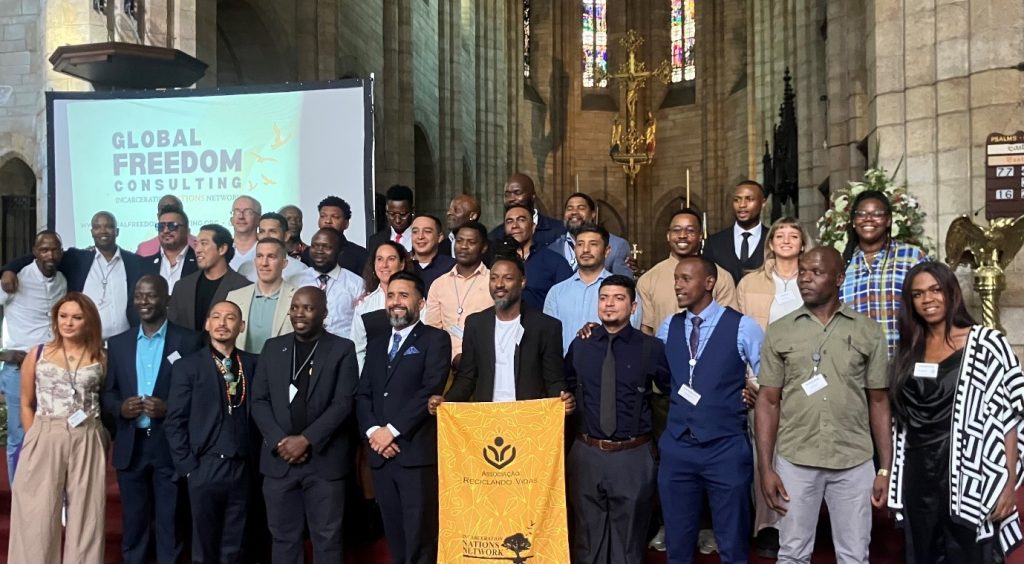
In April 2026, Incarceration Nations Network (INN) established by Baz Dreisinger convened a landmark global gathering in Cape Town, marking the international launch of the Global Freedom Consulting Agency (GF Consulting). This three-day event brought together policymakers, academics, and activists from more than 25 countries, signalling a paradigmatic shift in how expertise in criminal justice reform is conceptualised and mobilised. Launching the world’s first consulting agency composed of formerly incarcerated people from around the world, this event was the first of its kind. All of the consultants had taken part in the two-week Freedom Fellowship programme held at INN’s hub in Cape Town, which aims to bring people together from different countries who have been through prison systems and are now doing positive work. The Freedom Fellowship programme helps them to ‘connect, build, learn, be inspired, heal and feel joy.’ A team (Tammy Ayres, Lucy Evans, Elodie Laurent, Kellie Moss and Sonjah Stanley Niaah) from the Prisons, Drugs and Mental Health: An interdisciplinary global study attended this international interdisciplinary gathering on justice reform.
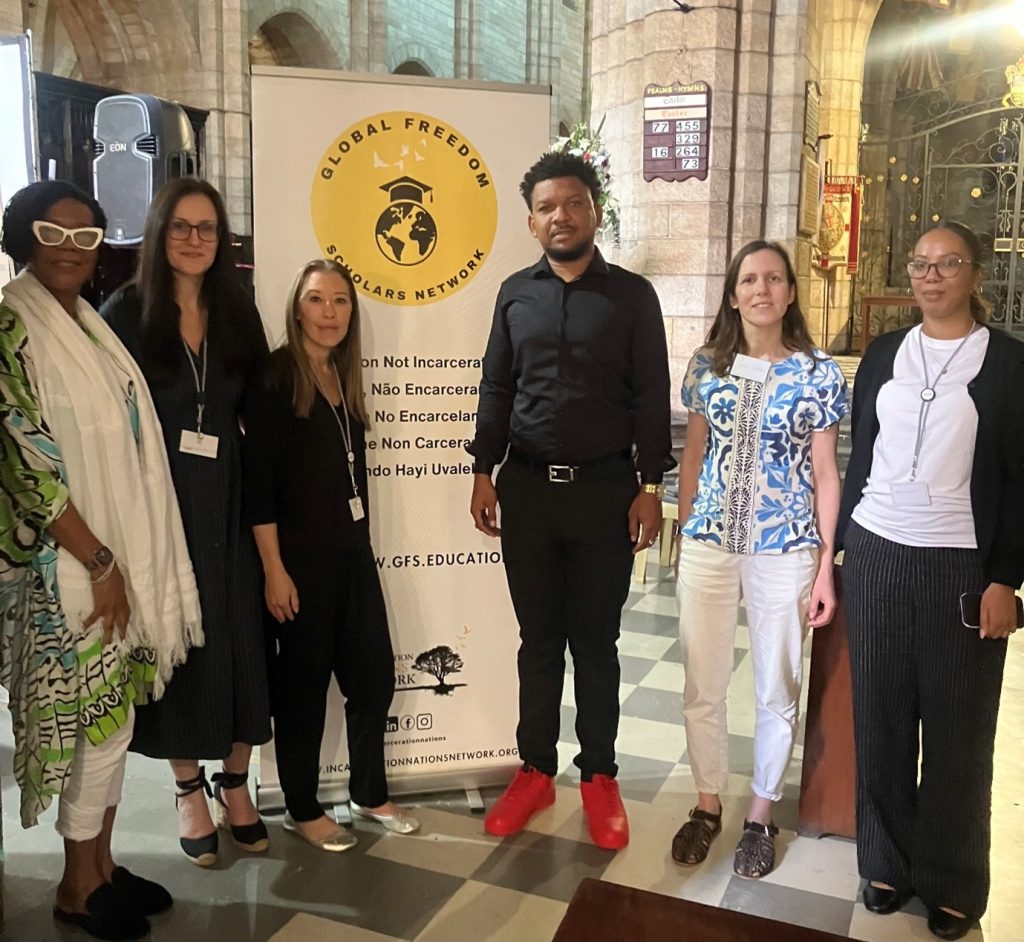
The Team and Nicholas Khan at the GFC event in St George’s Cathedral, South Africa
At its core, the event challenged dominant epistemologies of criminal justice by foregrounding lived experience as expertise. Although many of us put lived experiences at the forefront of our research, GF Consulting, formed from alumni of INN’s Global Freedom Fellowship, positions formerly incarcerated individuals not as subjects of reform but as architects of it. Over the past three years, the fellowship has trained leaders from 26 countries, many of whom now constitute a transnational network of consultants advising governments, institutions and civil society on issues ranging from education and reintegration to restorative justice.
Reframing Justice: From Punishment to Knowledge Production
The launch of GF Consulting represents a critical intervention in what scholars might describe as the politics of knowledge production within criminal justice systems. Traditionally, expertise has been monopolised by academics, legal professionals, policymakers and those in positions of power, often excluding those most directly affected by incarceration. This event disrupted that hierarchy.
At this event, lived experience was not treated as anecdotal but as analytical, strategic and indispensable for designing effective, context-sensitive interventions with real-world impact. This marks a shift that resonates with broader critical and decolonial frameworks, which interrogate whose knowledge counts and whose voices are systematically marginalised and excluded. By institutionalising formerly incarcerated leadership within a formal consulting structure, GF Consulting operationalises a counter-hegemonic epistemology; one that locates knowledge in embodied experience and social struggle, positioning lived experience at the centre of criminal justice solutions.
Education Not Incarceration: A Transnational Justice Movement
The event was not merely symbolic, but materially and geographically expansive. Hosted across historically and politically resonant sites, like St. George’s Cathedral and the Desmond and Leah Tutu Legacy Foundation, the event embedded contemporary justice reform within South Africa’s longer histories of resistance and reconciliation. The final day of the event was held at the Brandvlei Correctional Centre where we were joined by Unisa educators, prison officers and incarcerated people undertaking higher education and training,
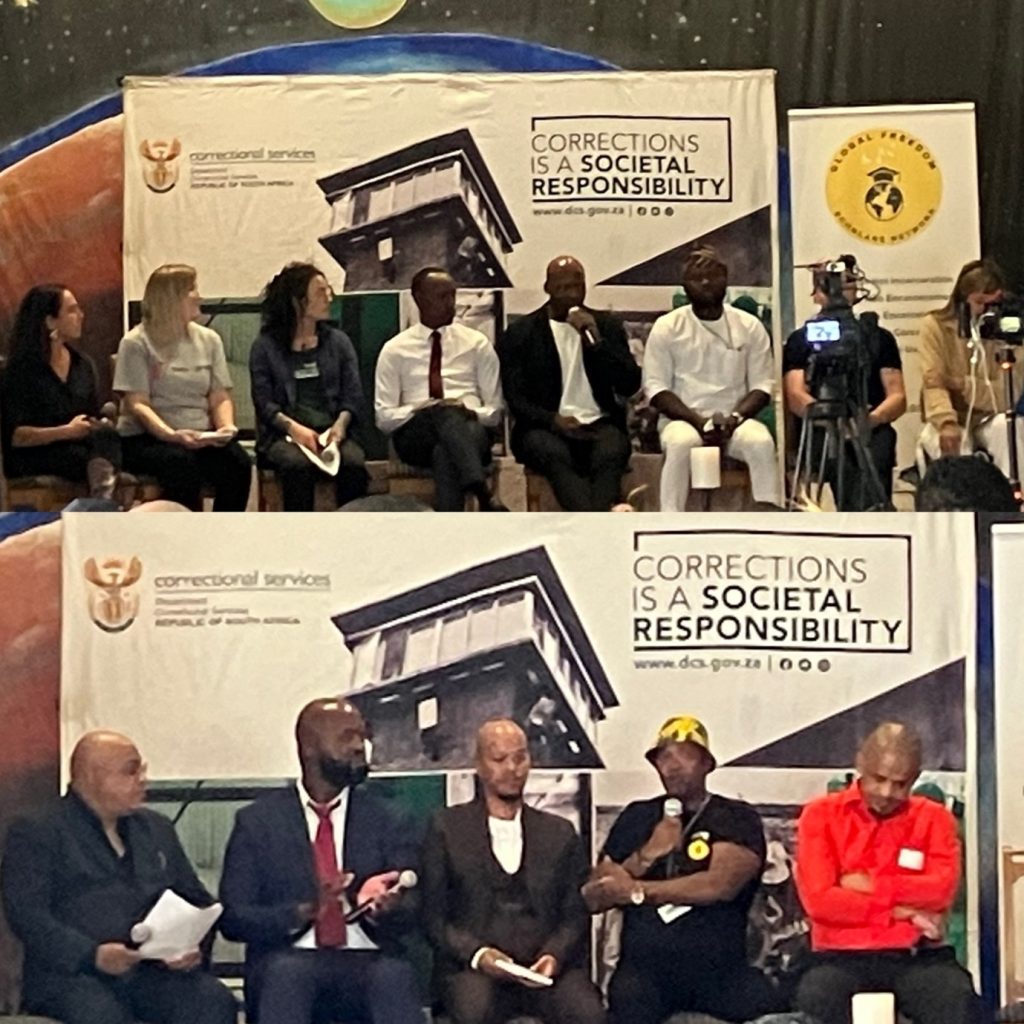
Event at Brandvlei Correctional Centre, South Africa – GF Scholars in Action and Unisa panel
The participation of global institutions, including the Office of the United Nations High Commissioner for Human Rights (OHCHR), alongside partners such as the Nelson Mandela Foundation and the Desmond and Leah Tutu Legacy Foundation, further underscored the international legitimacy and importance of this initiative. The presence of OHCHR’s regional representative for South Africa, Ms. Abigail Noko in the opening remarks signalled a recognition that justice reform is not solely a domestic policy issue but a global human rights imperative. Moreover, the diversity of participants and multi-lingual delivery highlighted the transnational nature of incarceration and its afterlives. Projects emerging from GF Consulting already demonstrate this global reach, including cross-border replication of intervention models and the development of international legal empowerment networks. We heard powerful and moving accounts from all of the Global Freedom Consultants at the event, some of who were unable to afford legal representation and had ended up being sentenced to death but studied law from their cells, organising and successfully arguing their appeal in the High Courts, and ultimately securing their own acquittal.
Lived Experience as Method and Praxis
What distinguished this event was not just the moving accounts and journeys of the Global Freedom Consultants, but their programmes, initiatives and drive to help and support others in similar positions. Panels, life stories, dialogues and performances, including spoken word poetry by Nicholas Khan, who wrote three poetry books in his cell (e.g. Nicko’s Ink), centred on what INN terms ‘justice innovation’ and ‘smart-on-crime’ approaches; frameworks that prioritise prevention, education and community-based solutions over punitive incarceration.
Importantly, the convening extended beyond conference spaces into sites of incarceration, such as Brandvlei Correctional Centre. Here discussions on education in prison foregrounded the transformative role of learning, aligning with South Africa’s longstanding histories, including the legacy of Nelson Mandela and his long walk to freedom, whose own intellectual formation during imprisonment continues to inform global imaginaries of resistance and rehabilitation. Other spaces included the Young Blood African Art Gallery, where the Writing on the Wall ‘pop-up art installation made from writings, drawings and notes by people in prison around the world’ was being exhibited.

Writing on the Wall Exhibition, at Young Blood African Art Gallery, South Africa
Critical Reflections
From an academic perspective, the launch of GF Consulting invites several critical reflections. Firstly, it challenges researchers and practitioners to reconsider methodological approaches that exclude justice-impacted voices and lived experiences. Even though there has been a growth in participatory action research and co-production, often this does not go far enough, and in some instances, ends up being tokenistic. What Baz Dreisinger has done is not only put lived experience at the centre but institutionalise it as a form of expertise reconfiguring the epistemic architecture of criminal justice work, thereby transforming it from a consultative add-on into a foundational driver of knowledge production, policy design, and justice innovation, which positions justice-impacted individuals as authoritative agents in the production of knowledge rather than its objects/subjects. Secondly, it foregrounds the need to move beyond reformist paradigms toward transformative justice frameworks that address structural inequalities underpinning mass incarceration. As many of us acknowledge in our work and as Baz does in her award-winning book Incarceration Nations, criminalisation and incarceration reflects broader social inequalities and racial hierarchies that can be traced back to historical colonial inequalities and power structures.
Therefore, the three-day event in Cape Town marked more than the launch of a new consultation network; it signalled a reorientation of global justice discourse. By positioning formerly incarcerated individuals as knowledge producers and policy advisors, Incarceration Nations Network has catalysed a shift from carceral logics toward models grounded in dignity, expertise and lived reality that are needed globally. As GF Consulting begins its work, the challenge will be to sustain this momentum to ensure that lived experience remains not only visible but authoritative in shaping the future of justice systems, rehabilitation and reintegration worldwide.